
Coupon Code at Yono Games: Structure, Activation Flow, and Entry Mechanics
The Coupon Code system at Yono Games represents a structured activation mechanism within the broader promotional framework. Unlike standard offers that activate automatically after a qualifying action, coupon-based promotions require an additional input layer. This input acts as a trigger that connects the user to a specific campaign logic, allowing access to a predefined promotional structure that may not be visible by default.
At a fundamental level, a coupon code is not just a string of characters. It is a key that links an account to a specific promotional route within the system. This route is defined by conditions, timing, and value mapping rules that determine how the promotion behaves after activation. Because of this, coupon codes should be viewed as entry points into targeted campaign segments rather than standalone promotional elements.
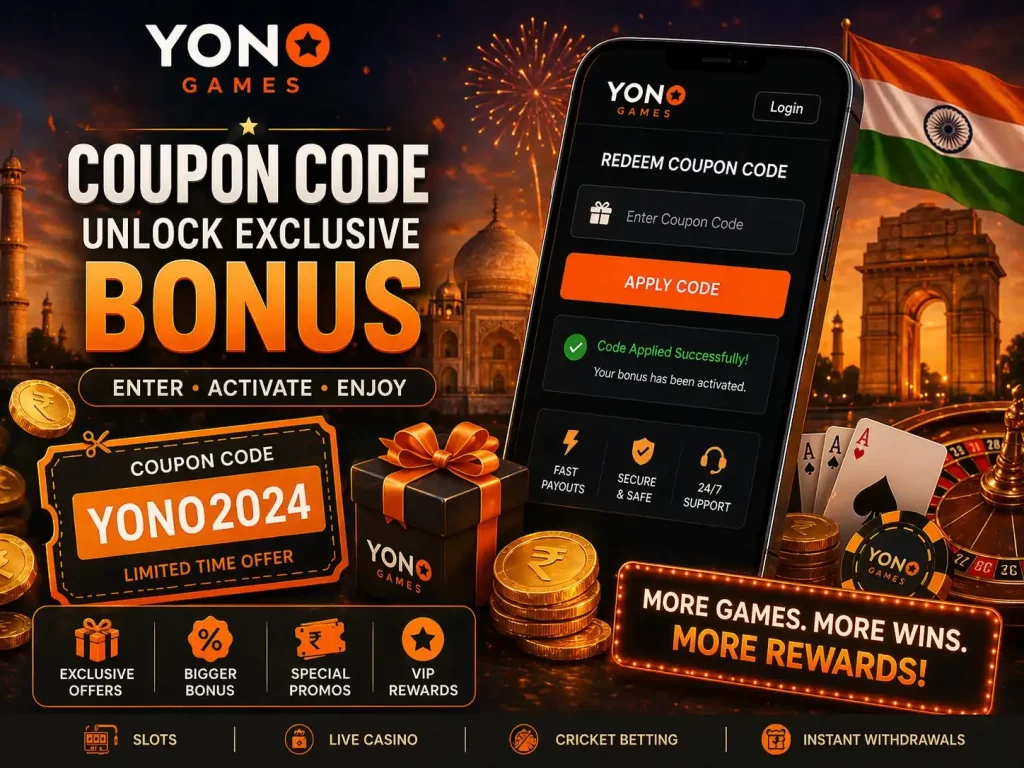
The activation flow of a coupon code follows a defined sequence. The first stage is acquisition, where the code is obtained from a valid source. The second stage is input, where the code is entered into the system. The third stage is validation, where the platform verifies whether the code is active, valid, and applicable to the account. The final stage is activation, where the system applies the associated promotional structure.
This sequence is important because each step is required for the system to recognize the code correctly. If any part of the sequence is incomplete or invalid, the activation does not proceed. This creates a controlled entry system where access to specific promotions is gated through both user action and system validation.
Another important aspect is that coupon codes often operate within defined time windows. A code may only be valid for a specific period, after which it expires and can no longer be used. This time-based limitation ensures that the promotional structure remains aligned with campaign schedules and prevents outdated codes from being applied outside their intended context.
| Stage | System Action | Trigger Point | Outcome |
|---|---|---|---|
| Acquisition | Code is obtained | External or internal source | Ready for use |
| Input | Code entered into system | User submission | Pending validation |
| Validation | System checks code status | Code verification | Approved or rejected |
| Activation | Promotion applied | Successful validation | Active campaign |
From a structural perspective, coupon codes also introduce a layer of selectivity into the promotional system. Not all users have access to the same codes, and not all codes apply to every account. This creates a segmented environment where different codes unlock different campaign paths. As a result, the coupon system functions as a routing mechanism that directs accounts into specific promotional flows.
Another key factor is how coupon codes interact with the broader account lifecycle. In many cases, the code is entered shortly after login, connecting the account to a campaign at an early stage. This ensures that the promotional structure becomes active within the correct timeframe and aligns with the account’s current status.
It is also important to understand that coupon codes do not operate independently of other promotional rules. Once activated, they follow the same structural logic as other campaigns. This includes timing constraints, condition layers, and value mapping rules. The only difference is the entry point, which is controlled by the code itself rather than an automatic trigger.
| Component | Definition | Function | Role |
|---|---|---|---|
| Code Input | User-provided key | Triggers system check | Activation entry |
| Validation Logic | Checks code eligibility | Approves or rejects | Control layer |
| Campaign Mapping | Links code to offer | Assigns structure | Core logic |
| Duration | Defines validity period | Limits usage | Lifecycle boundary |
The coupon system can also interact with specific activity segments within the platform. For example, certain codes may apply differently depending on how the system categorizes activity types such as Slots. This does not change the core activation flow, but it introduces variation in how the promotional structure behaves after activation.
Another aspect to consider is that coupon codes often serve as a gateway into more specialized promotional campaigns. While the initial structure may appear simple, the activated campaign can include multiple layers of rules and conditions that extend beyond the initial entry point. This makes the coupon code system a flexible tool within the broader promotional environment.
In summary, the Coupon Code system at Yono Games functions as a structured activation mechanism that connects users to specific promotional campaigns. It is built on a sequence of acquisition, input, validation, and activation, and it operates within defined timing and rule-based constraints. By understanding this structure, it becomes clear how coupon codes serve as controlled entry points into targeted promotional flows within the broader system.
Coupon Code Models, Code Types, and Value Distribution Logic
After understanding the activation flow of coupon codes, the next step is to analyze how different coupon models are structured and how they distribute value within the system. At Yono Games, coupon codes are not uniform in design. Instead, they follow several distinct models that determine how value is assigned, how campaigns are triggered, and how the internal structure behaves after activation.
A coupon code model defines the internal format of the campaign linked to the code. It determines whether the value is applied instantly, divided into multiple stages, or influenced by additional conditions. Even when two codes appear similar, their internal models can produce very different outcomes depending on how value is mapped and distributed.
The first model is the direct activation code. In this structure, the coupon code immediately triggers the full promotional mapping once it passes validation. There are no additional stages or delayed components. The system applies the entire structure in a single step, making this model the most straightforward and linear.
The second model is the staged coupon code. In this format, the code activates a multi-step structure where value is distributed across several stages. Each stage may require separate actions or conditions to unlock. Instead of receiving the full value at once, the system releases it incrementally. This creates a layered progression path within the same campaign.
The third model is the hybrid coupon code. This structure combines instant and delayed elements. A portion of the value is assigned immediately after activation, while the rest is distributed across later stages. This dual-phase system allows the code to function both as an entry trigger and as a progression mechanism.
Another important variation is the conditional coupon code. In this model, the outcome of the code depends on additional factors such as timing, eligibility filters, or internal thresholds. The code itself remains valid, but the structure it unlocks may change depending on the context in which it is used.
| Code Model | Structure | Activation Behavior | Value Distribution |
|---|---|---|---|
| Direct | Single-step mapping | Instant activation | Full value immediately |
| Staged | Multi-layer structure | Sequential unlocking | Split across stages |
| Hybrid | Mixed structure | Immediate + delayed | Partial instant, partial later |
| Conditional | Adaptive mapping | Depends on context | Variable structure |
Beyond structural models, coupon codes can also be categorized by type. This classification focuses on how codes are distributed and how they are intended to be used within the system. Some codes are universal, meaning they apply to a wide range of accounts. Others are limited to specific campaigns, events, or user segments. There are also time-sensitive codes that operate within strict activation windows.
These types introduce an additional layer of segmentation into the coupon system. Instead of a single pool of codes, the system is divided into multiple categories, each serving a different purpose. This segmentation allows the platform to control how promotions are distributed and how different campaign paths are accessed.
| Code Type | Availability | Usage Scope | Timing Logic |
|---|---|---|---|
| Universal | Widely distributed | Broad access | Long validity |
| Event-Based | Limited distribution | Campaign-specific | Fixed event window |
| Exclusive | Restricted access | Segment-based | Conditional validity |
Another key aspect is value distribution within each model. Even when the structure is clearly defined, the way value is allocated can vary. Some coupon codes are front-loaded, delivering most of the value immediately after activation. Others follow a balanced distribution, where value is spread evenly across stages. There are also back-loaded structures, where the majority of value is assigned later in the progression.
These distribution patterns directly affect how the system behaves over time. A front-loaded code creates a steep early progression, while a back-loaded structure delays most of the value until later stages. This variation adds flexibility to the coupon system and allows different campaigns to operate under different progression dynamics.
Timing also plays a role in how coupon codes function. Some codes activate instantly and apply their full structure immediately. Others operate within a sequential timing model, where stages unlock over time. There are also delayed activation codes, where certain parts of the campaign only become available after a defined interval.
This timing layer adds another dimension to the system. It ensures that even within the same structural model, the behavior of a coupon code can vary depending on how timing rules are applied.
In some cases, coupon codes may also interact with specific activity categories, creating variations in how value is processed. This can include segments linked to Slots, where certain rules or structures apply differently. These variations do not change the overall model but introduce additional flexibility within the system.
In summary, coupon codes at Yono Games are built using multiple models and types, each with its own structure, timing, and value distribution logic. These elements define how the system behaves after activation and determine how value is delivered across different stages. Understanding these variations provides a deeper view of how coupon codes function within the broader promotional framework.
Coupon Code Conditions, Wagering Rules, and System Constraints
After defining coupon code models and value distribution patterns, the next layer to analyze is the condition system that governs how coupon-based promotions operate after activation. At Yono Games, this system is built on a set of interconnected rules that determine how value is processed, how progress is tracked, and how the final outcome is evaluated. These rules transform a simple code entry into a fully structured progression system.
The first key component is the qualification layer. Even after a valid coupon code is entered, the system must confirm that all required conditions are satisfied before applying the full promotional structure. These conditions may include minimum thresholds, valid activity types, and timing constraints. If any of these requirements are not met, the system may restrict activation or limit the available structure.
The second component is the wagering system. Once a coupon code activates a promotion, the assigned value is typically linked to a required activity volume. This volume is defined through a multiplier, which determines how much total activity must be completed before the system considers the process finished. Instead of functioning as a static value, the promotion becomes part of a dynamic progression system.
Wagering is not a one-time condition. It is a continuous process where each qualifying action contributes toward the total requirement. The system tracks this progress in real time, updating the remaining workload as activity accumulates. This creates a progression curve that evolves throughout the lifecycle of the coupon-based promotion.
Another important factor is contribution weighting. Not all actions contribute equally toward wagering completion. Some activities may count at full value, while others contribute at a reduced percentage. This creates a weighted system where the efficiency of progression depends not only on volume but also on how that volume is categorized within the system.
| Condition Layer | Function | Impact on Progress | Rule Format |
|---|---|---|---|
| Threshold | Defines minimum entry level | Controls activation | Fixed value |
| Wager Multiplier | Sets total requirement | Defines completion level | Multiplier-based |
| Contribution | Adjusts activity weight | Changes speed | Percentage logic |
| Time Limit | Defines duration | Limits progression window | Expiry-based |
Another critical aspect is rule interaction. Each condition influences the others, forming a combined system rather than operating independently. For example, a higher multiplier combined with a shorter time limit increases the intensity of the progression process. Conversely, a lower multiplier with a longer timeframe creates a more gradual progression curve.
Progress tracking is the central mechanism that reflects this interaction. Once the coupon code activates a campaign, the system continuously measures how much of the requirement has been completed. Each qualifying action reduces the remaining workload, creating a dynamic curve that changes in response to activity patterns and rule constraints.
Limitations are another essential part of the condition system. Some coupon-based promotions include caps that restrict how much activity can contribute within a given stage. Others define which types of actions are eligible for progression. These restrictions ensure that the system follows a controlled structure and prevents irregular progression patterns.
Segmentation also plays a role in shaping how coupon codes behave. Certain codes may apply different rule sets depending on context. This can include variations in contribution weighting or eligibility criteria. These adjustments allow the system to adapt to different campaign scenarios while maintaining a consistent core logic.
| Rule Interaction | Primary Effect | Secondary Impact | System Result |
|---|---|---|---|
| Multiplier + Time | Defines total workload | Controls pacing | Fast or slow progression |
| Contribution + Activity | Adjusts efficiency | Changes rate | Variable curve |
| Limits + Sequence | Caps activity | Prevents spikes | Stable progression |
Another aspect to consider is that all conditions remain active throughout the lifecycle of the coupon-based promotion. From the moment the code is activated until the campaign reaches its final state, every rule continues to apply. This ensures consistency and predictability in how the system behaves.
Coupon codes may also interact with different activity categories, introducing variations in how value is processed. For example, certain segments may apply specific contribution rules or weighting adjustments. These variations do not change the overall structure but provide additional flexibility within the system.
Finally, it is important to note that the entire condition system is designed to operate as a unified structure. Qualification, wagering, contribution weighting, timing, and limitations all work together to define how the coupon code behaves after activation. No single rule determines the outcome on its own. Instead, the final result is shaped by the combined effect of all active conditions.
In summary, coupon codes at Yono Games operate within a rule-driven system where multiple conditions interact continuously. These conditions define how value is processed, how progress is tracked, and how the system evaluates completion. Understanding this layer provides a complete view of how coupon-based promotions function within the broader promotional framework.
Coupon Code Lifecycle, Progression Paths, and Final Outcomes
With activation mechanics, structural models, and condition systems fully defined, the final step is to understand how coupon codes behave across their complete lifecycle. At Yono Games, every coupon-based promotion follows a structured path that begins with visibility and ends with a defined outcome. This lifecycle connects all previous layers into one continuous system and shows how the coupon code evolves from input to completion.
The lifecycle begins at the availability stage. At this point, the coupon code exists within the system but has not yet been used. It may be distributed through specific channels or assigned to particular segments, but it remains inactive until it is entered. This stage defines the starting position and establishes the conditions under which the code can be applied.
Once the code is entered and passes validation, the lifecycle moves into the activation phase. This is the moment when the coupon code transitions from a passive state into an active promotional structure. At this stage, all rule layers—qualification, wagering, contribution weighting, and timing—become operational. The system begins tracking progress immediately, and the coupon code becomes fully integrated into the account’s promotional environment.
The next phase is progression. This is the longest and most dynamic part of the lifecycle. During this stage, the system continuously processes activity and updates the current state. Each qualifying action contributes toward completion, and the interaction between different rules shapes how the progression curve evolves. Because of contribution weights and limitations, this curve is not perfectly linear. Instead, it reflects the combined influence of all active conditions.
| Lifecycle Stage | System State | Progress Range | Primary Driver |
|---|---|---|---|
| Availability | Code exists but unused | 0% | Distribution logic |
| Activation | Code applied successfully | 0–10% | Validation result |
| Progression | Ongoing accumulation | 10–90% | Rule interaction |
| Completion | Final evaluation | 90–100% | Remaining requirement |
As the system approaches the final stage, it evaluates whether all defined conditions have been satisfied within the available timeframe. This evaluation determines the final outcome of the coupon-based promotion. There are three primary outcome scenarios that define how the lifecycle ends.
The first outcome is full completion. In this scenario, all conditions are met before the expiration limit is reached. The system transitions into a completed state, and the full promotional structure reaches its intended endpoint.
The second outcome is partial progression. In this case, some progress has been made, but the system does not reach full completion before the time window closes. The lifecycle ends in an intermediate state that reflects partial fulfillment of the conditions.
The third outcome is expiration without progression. Here, the coupon code is activated but does not advance significantly before the expiry boundary is reached. The system transitions to its final state without meaningful progression.
Another important concept within the lifecycle is the existence of multiple progression paths. Not every coupon code follows the same trajectory. Depending on how rules interact, the system may support faster or slower progression routes. These routes are shaped by contribution efficiency, timing constraints, and activity distribution.
An accelerated path is characterized by rapid early progression, often driven by higher contribution efficiency. A balanced path follows a steady and consistent progression pattern. An extended path develops more slowly and may rely on longer interaction within the available timeframe.
| Progress Path | Pattern | Time Interaction | Outcome |
|---|---|---|---|
| Accelerated | Fast early accumulation | Short timeframe impact | Full completion |
| Balanced | Stable progression | Moderate duration | Conditional completion |
| Extended | Slow progression | Long timeframe | Partial result |
Time limits play a decisive role throughout the lifecycle. Regardless of how quickly or slowly progression occurs, the defined timeframe acts as a fixed boundary. Once this boundary is reached, the system finalizes the outcome. This makes timing one of the most influential factors in determining the final state of the coupon-based promotion.
Coupon codes may also behave consistently across different access environments, including mobile platforms such as the app. This ensures that the lifecycle remains stable regardless of where the code is entered or how the system is accessed.
In summary, coupon codes at Yono Games operate as complete lifecycle systems. They begin at availability, move through activation, evolve during progression, and end with a defined outcome. Each stage is shaped by rule interaction, timing constraints, and activity patterns. By understanding this lifecycle, it becomes clear how coupon-based promotions function as structured, end-to-end systems within the broader promotional framework.






Comments