Promotions at Yono Games: Core Structure, Entry Logic, and Promotional Categories
Promotions at Yono Games can be understood as a layered system of temporary and ongoing offers that shape how value is introduced, distributed, and managed across the platform environment. Rather than viewing promotions as isolated labels attached to individual campaigns, it is more useful to see them as a broad operational category that includes entry offers, recurring rewards, event-based incentives, and limited-time activations. This wider perspective creates a stronger foundation for understanding how the promotional section works as a whole and why different campaigns may follow different structures even when they appear similar on the surface.
A promotions page should begin by establishing this category clearly. Readers often arrive with a broad search intent. Some want to understand what types of offers are available. Others want to know how promotional systems are organized, how activation typically works, and what rules define access. Because of that, the opening section should not rush into narrow examples too early. It should first explain the architecture of promotions as a complete framework. Once that framework is clear, later sections can move into timing models, condition systems, and offer-specific paths with much better clarity.
The first thing to recognize is that promotions are rarely uniform. Even within the same platform, one offer may be designed as an entry-stage campaign, another may operate as a repeatable weekly format, and another may be tied to a seasonal schedule or event cycle. This means the promotional environment is not built around one rule set alone. Instead, it works as a collection of connected systems that each follow their own logic while still fitting under one umbrella. At Yono Games, this umbrella should be viewed as the promotions framework: a structured set of campaign types defined by timing, eligibility, value format, and activation flow.
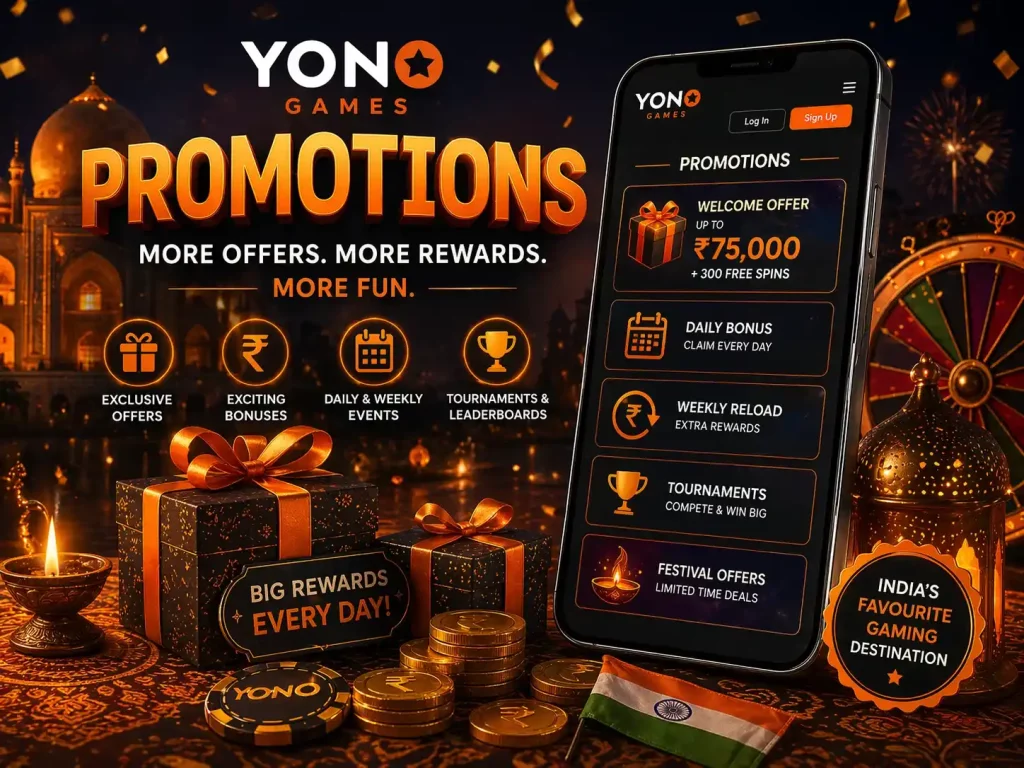
From a content perspective, this matters because a good SEO section on promotions should explain how the category is organized before exploring how individual offers behave. The category itself includes several major segments. There are introductory campaigns designed for first-time access. There are recurring promotions that reappear on daily, weekly, or monthly schedules. There are event-driven activations that appear for a fixed period tied to a larger calendar structure. There are also reward-based campaigns linked to specific thresholds or milestones. Each of these segments belongs to the same broader promotional environment, but each operates according to a slightly different internal logic.
This opening section should therefore define promotions not as a single reward, but as a campaign architecture. That architecture includes visibility, eligibility, trigger conditions, reward mapping, and active duration. These five layers together determine how a promotion actually functions. Visibility defines where the offer appears within the platform flow. Eligibility defines which account types or actions can access it. Trigger conditions specify what has to happen before activation is recognized. Reward mapping determines how value is attached to the campaign. Active duration defines how long the offer remains available before it expires or resets. When these layers are explained clearly, the reader gains a much stronger understanding of what promotions really are.
One useful way to frame the category is to divide it into functional classes. The first class is entry promotions. These are designed to introduce the promotional framework and often serve as the earliest visible campaign layer for a new account. The second class is retention-cycle promotions, which operate on repeat schedules and are meant to exist beyond the initial entry stage. The third class is event-linked promotions, which appear during specific windows and may not be permanently available. The fourth class is milestone promotions, where access or value depends on achieving a defined internal checkpoint. Even if the reader is only searching for one specific type, explaining the wider system increases depth and improves the authority of the page.
Another important point is that promotional categories do not only differ in timing. They also differ in how they are activated. Some campaigns may begin automatically once the qualifying action is completed. Others may require a more explicit recognition stage in the promotional flow. Some are fixed to account status, while others are tied to a specific activity segment or a calendar event. This means the promotional framework is dynamic rather than static. Campaigns can be live, inactive, scheduled, rotating, or conditional depending on their design. That dynamic nature should be visible from the start of the page.
| Promotional Class | Primary Role | Activation Style | Typical Duration Logic |
|---|---|---|---|
| Entry Promotions | Introduce the first campaign layer for a new account. | Qualification-based activation | Short opening window |
| Recurring Promotions | Create repeatable promotional cycles across the platform. | Schedule-based activation | Daily, weekly, or monthly reset |
| Event Promotions | Support a time-limited campaign linked to a defined event period. | Window-based activation | Fixed campaign cycle |
| Milestone Promotions | Unlock value through thresholds, stages, or internal progress points. | Condition-based activation | Depends on progression completion |
A further layer to examine is the internal composition of a promotion itself. Even when a campaign is presented under a simple label, the underlying structure usually contains multiple components. There is often a visible headline, a qualifying condition, a mapped value range, a validity window, and a completion or expiry rule. This is why a promotions page benefits from a system-first approach. If the text focuses only on visible campaign names, it misses the deeper operational logic that actually defines how promotions work.
At Yono Games, the promotional category should also be viewed as a routing mechanism. Different campaigns guide the account through different entry paths. Some offers are meant to activate at the beginning of the account journey. Others exist later in the platform cycle. Some depend on schedule visibility, and others depend on internal qualification. The result is a promotions environment that behaves more like a network of campaign routes than a flat list of reward labels. Once that idea is established, the rest of the page can explain how different routes are structured and what kinds of rule systems control them.
This also makes it easier to understand why not every campaign should be read in the same way. A recurring offer is judged by its reset pattern and repeated access rules. An event promotion is judged by timing and availability window. A milestone offer is judged by progression requirements. An entry-stage campaign is judged by first-access conditions. They all belong to the same family, but their logic is distinct. That is why the first section must separate category from example and system from label.
| System Layer | What It Defines | Why It Matters | Common Structure Type |
|---|---|---|---|
| Visibility Layer | Where and when the campaign becomes visible. | Shapes discovery and timing context. | Static, rotating, or event-based |
| Eligibility Layer | Which accounts or actions can access the offer. | Defines campaign scope. | New, recurring, or conditional access |
| Trigger Layer | What event activates the campaign logic. | Controls campaign start point. | Automatic or condition-led |
| Value Layer | How promotional value is assigned or distributed. | Determines offer format and scale. | Fixed, tiered, or progressive mapping |
Another useful angle is category distribution. Not every promotions section is weighted equally toward the same types of campaigns. Some promotional systems are heavier on rotating offers. Others emphasize onboarding campaigns and milestone-based formats. Some distribute attention more evenly across all promotional classes. This internal balance affects how the overall page should be read, because it shows which campaign families dominate the structure. In long-form SEO writing, this kind of breakdown adds analytical depth and makes the content feel more complete.
It is also important to note that the promotions environment often extends across multiple access points within the same platform structure. A campaign may be visible from the main promotional area, from a schedule-linked entry point, or from a specific account path after qualification is completed. In practical terms, that means promotions are not only a content category; they are also a navigation and activation framework. The page should explain this without getting lost in interface details, because the real focus remains the logic of campaign organization.
The category can also be approached through value behavior. Some promotions distribute value immediately once conditions are satisfied. Others split value across several checkpoints. Some operate through a short-term window with a direct outcome. Others remain active as part of a longer cycle. The same is true for how reward logic is processed. One campaign may complete in a single activation stage, while another may unfold gradually. This range of behaviors confirms why promotions should be treated as a family of systems rather than a single template.
That distinction becomes especially useful when discussing platform-wide consistency. Even if campaign types differ, the page should present the entire promotional structure as a coherent environment. This means recurring offers, event campaigns, milestone mechanics, and entry-stage promotions all belong to one connected logic. Their individual rules may vary, but their role within the category remains the same: they define how temporary or repeatable value enters the platform cycle. A strong first section should make that relationship clear.
One carefully placed example of this can be seen in how a promotional system may assign different paths to different activity categories, including segments linked to Slots, while still keeping them under one wider campaign framework. The important point here is not the category itself, but the fact that a promotion can be shaped differently depending on the path it follows. This reinforces the idea that the promotional structure is modular and that each offer should be understood in relation to its route, timing, and activation logic.
Finally, the opening section should establish the central idea that promotions at Yono Games are best understood as a structured operational network. They are built from campaign classes, internal rule layers, timed windows, and value-mapping systems. This provides the right base for everything that follows in the later sections. Once the reader understands the category at this level, it becomes much easier to explore how recurring logic works, how terms interact with campaign types, and how promotional lifecycles move from visibility to completion.
At the category level, this is the most important conclusion: promotions are not just campaign names displayed in a list. They are an organized system built from timing, qualification, structure, and value flow. By defining them this way from the beginning, the page becomes stronger, more analytical, and much easier to extend into the next sections. That is exactly why this first stage matters. It sets the foundation for a much deeper explanation of how promotions function in practice across the Yono Games environment, without reducing the topic to a single offer type or a flat promotional summary.
Promotions Models, Timing Cycles, and Distribution Logic
After defining promotions as a structured category, the next step is to examine how different promotional models are built and how they behave over time. At Yono Games, promotions do not follow a single fixed pattern. Instead, they are constructed using a range of models that determine how value is distributed, how often campaigns repeat, and how timing influences the overall structure.
The concept of a promotions model refers to the internal format of a campaign. This includes how value is delivered, whether the offer operates in a single stage or multiple stages, and how the timing cycle affects availability. These models are essential because they define how each promotion behaves in practice. Even when two campaigns appear similar, their underlying models may create very different outcomes in terms of activation flow and value distribution.
The first model to consider is the single-cycle promotion. This is the most straightforward format, where the campaign activates once, runs through its defined duration, and then ends. There is no repetition built into the system, and the entire structure exists within one continuous time window. This type of promotion is typically used for fixed campaigns with clearly defined start and end points.
The second model is the recurring-cycle promotion. Unlike single-cycle campaigns, recurring promotions reset after a specific interval. This interval can be daily, weekly, or monthly, depending on how the system is configured. Each reset creates a new cycle, allowing the promotion to repeat under the same or slightly modified conditions. This model introduces continuity into the promotional structure, as it creates a pattern that extends beyond a single activation window.
A third model is the progressive promotion. In this structure, value is distributed across multiple stages that build on each other over time. Instead of a single activation point, the campaign evolves as different thresholds are reached. This creates a layered system where each stage contributes to the overall progression. Progressive models often include checkpoints or milestones that define how value is unlocked step by step.
Another important variation is the time-gated promotion. In this case, access to certain parts of the campaign is controlled by timing rules rather than immediate eligibility. For example, a promotion may unlock additional value after a defined period or only during specific time windows. This introduces a temporal dimension where availability is as important as qualification.
These models are not mutually exclusive. In many cases, a promotion may combine elements from multiple models. A recurring campaign can also include progressive stages. A time-gated structure can exist within a single-cycle framework. This flexibility allows the promotional system to adapt to different use cases while maintaining a consistent overall structure.
| Model Type | Core Structure | Timing Logic | Value Distribution |
|---|---|---|---|
| Single-Cycle | One continuous campaign window | Fixed start and end | Full value within one cycle |
| Recurring-Cycle | Repeating campaign structure | Scheduled resets | Distributed across multiple cycles |
| Progressive | Multi-stage progression system | Stage-based unlocking | Incremental value release |
| Time-Gated | Access controlled by timing rules | Delayed or window-based activation | Segmented availability |
Timing plays a central role in all promotional models. It defines not only when a campaign starts and ends, but also how it behaves within that period. For example, a recurring promotion may reset every week, but the internal progression within each cycle may still follow a progressive pattern. Similarly, a time-gated promotion may unlock different stages at predefined intervals, creating a layered timeline rather than a single continuous flow.
Another dimension of timing is synchronization. Some promotions operate independently, meaning their cycles are not aligned with others. Others are synchronized with broader campaign schedules or platform-wide events. This synchronization creates clusters of activity where multiple promotions become active simultaneously. From a structural standpoint, this adds another layer of complexity, as timing must be understood both at the individual campaign level and at the system level.
In addition to timing, distribution logic defines how value is allocated within each promotional model. Distribution can be front-loaded, evenly distributed, or back-loaded depending on how the campaign is designed. A front-loaded promotion delivers most of its value early in the cycle, while a back-loaded structure places more emphasis on later stages. An even distribution spreads value across all stages in a balanced way.
This distribution logic directly interacts with the model type. For example, a progressive promotion with a back-loaded distribution will feel very different from a recurring promotion with an even distribution. Even though both belong to the same category, their internal dynamics create distinct progression patterns. Understanding this interaction is essential for interpreting how promotions behave over time.
| Distribution Type | Allocation Pattern | Progression Impact | Typical Usage |
|---|---|---|---|
| Front-Loaded | Higher value at early stages | Fast initial progression | Entry and short-cycle campaigns |
| Even Distribution | Balanced value across stages | Stable progression curve | Recurring promotions |
| Back-Loaded | Higher value at later stages | Slower early progression | Progressive campaigns |
Another factor that influences promotional models is access point consistency. Promotions are often accessible through multiple entry paths, including account-level triggers and campaign-specific activation flows. This means that the same model may behave differently depending on where and how it is accessed. For example, a recurring promotion may appear as part of a scheduled cycle but still require a valid login state to become visible and active.
It is also important to consider how promotional models interact with different activity segments within the platform. Certain campaigns may be structured to align with specific categories or types of engagement, which can affect how value is distributed and how progression is tracked. These interactions reinforce the idea that promotions are not isolated structures but part of a broader system that adapts to different contexts.
Finally, access flexibility across different environments also plays a role. Promotions are often designed to remain consistent whether accessed through a desktop interface or a mobile app. This ensures that the underlying model remains unchanged even if the entry point differs. From a structural perspective, this consistency supports a unified promotional system where models behave predictably regardless of how they are accessed.
In summary, promotions at Yono Games are built using a combination of models, timing cycles, and distribution patterns. Each model defines how the campaign operates, while timing determines when it is active and distribution defines how value is allocated. Together, these elements create a flexible system that can support a wide range of campaign types while maintaining a consistent structural foundation.
Promotions Conditions, Rule Systems, and Wagering Mechanics
After exploring promotional models and timing cycles, the next layer to analyze is the rule system that defines how promotions operate once they are active. At Yono Games, this layer is built around a set of conditions that determine how campaigns are activated, how progress is tracked, and how value transitions from one state to another. These rules are not optional details. They form the operational logic that governs every promotion regardless of its model or timing structure.
The first key component is the qualification layer. Even if a promotion is visible within the platform, it does not automatically mean it is active. The system must first confirm that the account meets the defined requirements. These requirements can include thresholds, valid transaction types, timing windows, and campaign-specific rules. Only after these conditions are satisfied does the system move into the active state where progress tracking begins.
The second major component is the wagering structure. This defines how promotional value is processed after activation. Instead of acting as a static balance, the value is typically linked to a required activity volume that must be completed before it transitions into a final state. This requirement is often represented as a multiplier applied to the initial value, creating a measurable target that defines completion.
Wagering should be understood as a progression system rather than a single condition. Each action contributes incrementally toward the total requirement. The system continuously updates the remaining amount until the full requirement is met or the campaign expires. This makes the wagering layer dynamic, as it evolves based on activity rather than remaining fixed after activation.
Another important factor is contribution weighting. Not all actions contribute equally toward wagering completion. Some activities may count at full value, while others contribute partially. This creates a weighted system where the same amount of activity can produce different levels of progress depending on how it is categorized. Understanding this weighting system is essential because it directly affects how quickly the overall requirement can be completed.
| Condition Type | Function | Impact on Campaign | Rule Format |
|---|---|---|---|
| Minimum Threshold | Defines entry requirements for activation | Controls initial eligibility | Fixed numeric value |
| Wager Multiplier | Specifies total required activity | Defines completion target | Multiplier-based rule |
| Contribution Weight | Adjusts how actions count | Alters progression speed | Percentage-based logic |
| Time Limit | Defines campaign duration | Limits progression window | Fixed expiry period |
Another important aspect is rule interaction. Each condition does not operate independently. Instead, they form a combined system where multiple rules influence each other simultaneously. For example, a higher multiplier combined with a shorter time limit creates a more demanding structure, while a lower multiplier with a longer duration produces a more extended progression cycle. These interactions define how the promotion behaves under real conditions.
Progress tracking is also a central part of this system. Once a promotion becomes active, the platform continuously measures how much of the requirement has been completed. This tracking is incremental and dynamic. Each qualifying action updates the current state, reducing the remaining requirement until completion is reached or the campaign expires. The system effectively creates a real-time progression curve that reflects how conditions are being satisfied.
In addition to progression, limitations also play a role in shaping promotional behavior. Some campaigns include caps that restrict how much activity can contribute within a given step. Others limit which actions are eligible under the promotion. These restrictions are part of the broader rule system and ensure that progression follows the intended structure.
Another factor is segmentation. Certain promotions may apply different rule sets depending on the context in which they are used. For example, activity linked to specific categories may follow different contribution rules compared to others. This segmentation allows the promotional system to adapt to different use cases while maintaining a consistent core structure.
| Rule Interaction | Primary Effect | Secondary Impact | System Outcome |
|---|---|---|---|
| Multiplier + Time | Defines total workload | Controls pacing | Fast or slow progression |
| Weight + Activity | Adjusts contribution rate | Changes efficiency | Variable speed |
| Limit + Sequence | Caps per-step usage | Prevents rapid completion | Stabilized curve |
nally, it is important to understand that all these conditions operate simultaneously throughout the lifecycle of a promotion. Once activated, the system continuously applies all rules until the campaign reaches its final state. This creates a consistent and predictable structure where progression is always governed by the same set of conditions.
In summary, promotions at Yono Games are controlled by a rule-based system that includes qualification, wagering, contribution weighting, timing, and interaction logic. These elements work together to define how campaigns behave once they are active. By understanding this layer, it becomes possible to see how promotional models translate into real operational behavior, setting the stage for the final section where the full lifecycle and outcome paths will be explored.
Promotions Lifecycle, Completion Scenarios, and System Outcomes
Once promotional models and rule systems are clearly defined, the final step is to examine how promotions behave across their full lifecycle. At Yono Games, this lifecycle represents the complete journey of a campaign, starting from its initial visibility and activation, moving through active progression, and ending with a defined outcome. Viewing promotions through this lifecycle lens connects all previous sections into one unified system and shows how each component contributes to the final result.
The lifecycle begins at the visibility stage. At this point, the promotion exists within the platform environment but has not yet been activated. It is discoverable through different entry points and remains inactive until the qualification conditions are met. This stage is important because it defines the starting point of the promotional journey and determines when the system begins to apply its internal rules.
Once the required conditions are satisfied, the lifecycle moves into the activation phase. This is the moment when the campaign transitions from a passive state to an active one. From this point onward, all rule layers—qualification, wagering, contribution weighting, and timing—begin to operate simultaneously. The system starts tracking progress and continuously updates the current state based on activity.
The next stage is the progression phase. This is where most of the lifecycle takes place. During this period, the system accumulates progress incrementally. Each qualifying action contributes toward the total requirement, and the interaction between different rules shapes how quickly or slowly the system moves forward. Because contribution weights and limits vary, progression is rarely linear. Instead, it follows a dynamic curve that reflects how different conditions interact over time.
| Lifecycle Stage | System State | Progress Range | Key Driver |
|---|---|---|---|
| Visibility | Campaign is available but inactive | 0% | Eligibility layer |
| Activation | Promotion becomes active | 0–5% | Trigger conditions |
| Progression | Ongoing accumulation of activity | 5–90% | Rule interaction |
| Completion | Final requirement stage | 90–100% | Remaining workload |
As the promotion approaches the final stage, the system evaluates whether all conditions have been satisfied within the defined timeframe. This evaluation determines the outcome of the lifecycle. There are typically three main outcomes that define how a promotion concludes.
The first outcome is full completion. In this scenario, all conditions are met before the time limit expires. The system transitions into a completed state, and the promotional structure reaches its intended endpoint. The second outcome is partial completion, where some progress has been made but the campaign does not reach full completion before the expiry window closes. The third outcome is expiration without meaningful progress, where the campaign ends before any significant progression occurs.
These outcomes are not separate from the rule system. They are direct results of how the system processes activity, time, and conditions together. Because all rules operate simultaneously, the final state reflects the combined effect of every component rather than any single factor.
Another important concept within the lifecycle is the existence of multiple progression paths. Not every promotion follows the same route toward completion. Depending on how rules interact, the system may allow different paths that lead to different outcomes. Some paths are faster due to higher contribution efficiency, while others are slower due to stricter limits or lower weighting.
This variability creates a branching structure within the lifecycle. Instead of a single linear path, the system supports multiple possible trajectories. Each trajectory is shaped by the interaction between activity, rules, and time constraints. This is why the same promotion can produce different outcomes under different conditions, even though the underlying structure remains consistent.
| Progress Path | Pattern | Time Interaction | Result |
|---|---|---|---|
| Accelerated Path | Fast early progression | Short timeframe | Full completion |
| Balanced Path | Steady progression | Moderate timeframe | Conditional completion |
| Extended Path | Slow accumulation | Long timeframe | Partial result |
t is also important to consider the role of time limits within the lifecycle. Time acts as a fixed boundary that defines the maximum duration of the promotion. Regardless of how much progress has been made, once this boundary is reached, the system transitions into its final state. This makes time one of the most decisive factors in determining the outcome of a campaign.
Finally, the lifecycle demonstrates how all previous elements—models, timing, and rule systems—connect into a single operational flow. Promotions begin as visible opportunities, become active through defined conditions, evolve through progressive interaction with rules, and end with a clear outcome based on completion status.
In summary, promotions at Yono Games function as complete lifecycle systems. Each campaign follows a structured path from visibility to outcome, shaped by rule interaction, timing constraints, and progression dynamics. By understanding this lifecycle, it becomes possible to see how the entire promotional environment operates as a cohesive system rather than a collection of isolated campaigns.






Comments